
Arizona's Dated Trail for Past Households
Arizona house histories pair ownership records with dated occupant clues. Access varies by Arizona county: Maricopa reports a two-year full-text window and an older indexed collection, while Pima's historic index is incomplete. The Arizona State Library and local libraries hold selected directories, newspapers, maps, and county files.
| Record source | Years or reach | Where it is held | Clue for a past household |
|---|---|---|---|
| Maricopa County, Arizona, deeds | Broader index reported to 1871; current full-text instructions state two years | Arizona's Maricopa County Recorder | Parties, dates, document type, legal description, and image options |
| Pima County, Arizona, deeds | Historic index is incomplete | Pima County Recorder, Arizona | Grantor, grantee, recording date, type, related item, and image |
| Arizona city and business directories | Selected digital material, 1881–1989; local gaps | Arizona Memory Project and Arizona State Library | Name, street address, work, spouse, and volume-specific status marks |
| Census schedules | Federal release follows a 72-year rule | Federal census collections and library access | Household names and period address or geography |
| Permit and code records | Arizona city and county start dates vary; no statewide archive located | Local planning or code custodian | Work dates and applicant or contractor clues |
| Maps and Sanborn sheets | State maps from the 1860s onward; town and sheet coverage varies | Arizona State Archives and selected online collections | Road, lot, building, and neighborhood context |
| Newspapers and probate | Digital newspaper coverage includes 1859–1989; microfilm continues beyond it | Arizona State Library, AMP, and Arizona Superior Court clerks | Obituary, sale, marriage, estate, heir, or last-address clues |
For previous residents in Arizona, start with the current parcel. Use the Arizona county recorder for title, directories and census for dated household clues, and Arizona maps for old street forms. Note the year and access method for each finding.
Fix the Arizona Address Before Searching
An Arizona parcel's old street label may differ today after annexation, road renaming, rural-route changes, or post-office shifts. Record house and unit number, direction, street, city, ZIP, Arizona county, APN, mailing address, and legal description separately. Situs locates land; a mailing address receives notices.
Copy owner, APN, legal description, subdivision, lot and block, and deed date from the Arizona county assessor. The street-level assessor search gives Maricopa County, Arizona, parcel, owner-name, and address formats; other Arizona counties use separate tools. Check an Arizona plat or map if the address differs. If today's city name fails, search the historical Arizona county, court district, town, or post office. Keep the old spelling; this is the base for a previous residents search.
Follow Arizona Grantors Back Through Deeds
Start with the current Arizona county assessor owner. Find the purchase deed and use its seller to locate the prior transfer. The chain of title is the sequence of Arizona county records passing a land interest; it does not show residents for each year.
- Copy the APN, owner, legal description, deed number, and date from the Arizona assessor.
- Search the Arizona county recorder by party, address, APN, legal description, or deed number.
- Save the grantor, grantee, date, Arizona document type, number, and image status.
- Search the prior grantor as a grantee in the Arizona index; check related releases, plats, or probate transfers.
- If the Arizona online index ends, ask about the county counter, deed books, microfilm, copy orders, or requests.
- Grantor and grantee
- The grantor gives or transfers the recorded interest; the grantee receives it.
- Legal description
- Words or lot-and-block references that identify land in a deed, even when the street label has changed.
- Chain of title
- The sequence of recorded transfers that traces ownership of a parcel.
- Criss-cross directory
- A book arranged by street address so a researcher can find the name listed there in a given year.
- Enumeration district
- A geographic area assigned to a census taker; its boundary may not match a street or city limit.
Maricopa County, Arizona: 1871 Index and Two-Year Window
Maricopa County, Arizona, reports more than 52 million searchable documents dating to 1871 and about 2,500 documents indexed each day. Yet its current full-text page says retrieval pulls the last two years. These are different measures: the short window does not mean older deeds are absent from every Arizona index or archive. For previous residents, ask whether an older Arizona index or book covers the parcel's date.
The Arizona Recorder's Maricopa County research page accepts names, legal descriptions, or addresses, with exact phrase, AND, OR, exclusion, and thesaurus syntax.
| Search part | Recorded-document use |
|---|---|
| Search text | Name, address, legal description, exact phrase, AND, OR, exclusion, or thesaurus term. |
| Business name | Optional search for a trust, subdivision, HOA, or business party. |
| Document code | Optional filter for deed, deed of trust, divorce deed, easement, lien, plat, release, or sheriff's deed. |
| Date range | Optional narrowing field; available controls can depend on the current search screen. |
Online images from the Arizona recorder index are watermarked and unofficial. The Maricopa County Recorder's copy fee schedule lists official copies at $1 per page and certified copies at $1 per page plus $3 per document. Confirm charges before ordering. Its Arizona request forms allow online, email, or fax requests, including inspection without a copy.
Arizona Historic Images in Pima County Have a Counter Route
In Pima County, Arizona, the Public Records Research portal offers free watermarked views, not official copies. Official records can be bought for pickup, email (about two days), or mail (about seven days). Historic images are available at Tucson counters even when Pima's historic index lacks an entry. For a previous residents search, this free-view versus paid-copy distinction matters when a deed image must be cited or kept.
Pima County, Arizona, search results show the recording date, document type, page count, grantor, grantee, and related item. Save those fields, then ask for an image or older record that does not appear online.
| Index field | What to preserve |
|---|---|
| Recording date | When the instrument entered the Arizona county record. |
| Document type and page count | The kind of filing and length of the image or copy. |
| Grantor and grantee | The parties transferring and receiving the recorded interest. |
| Related item | A linked record to request with the main document. |
View Pima's search entry point before choosing an online search or counter request.
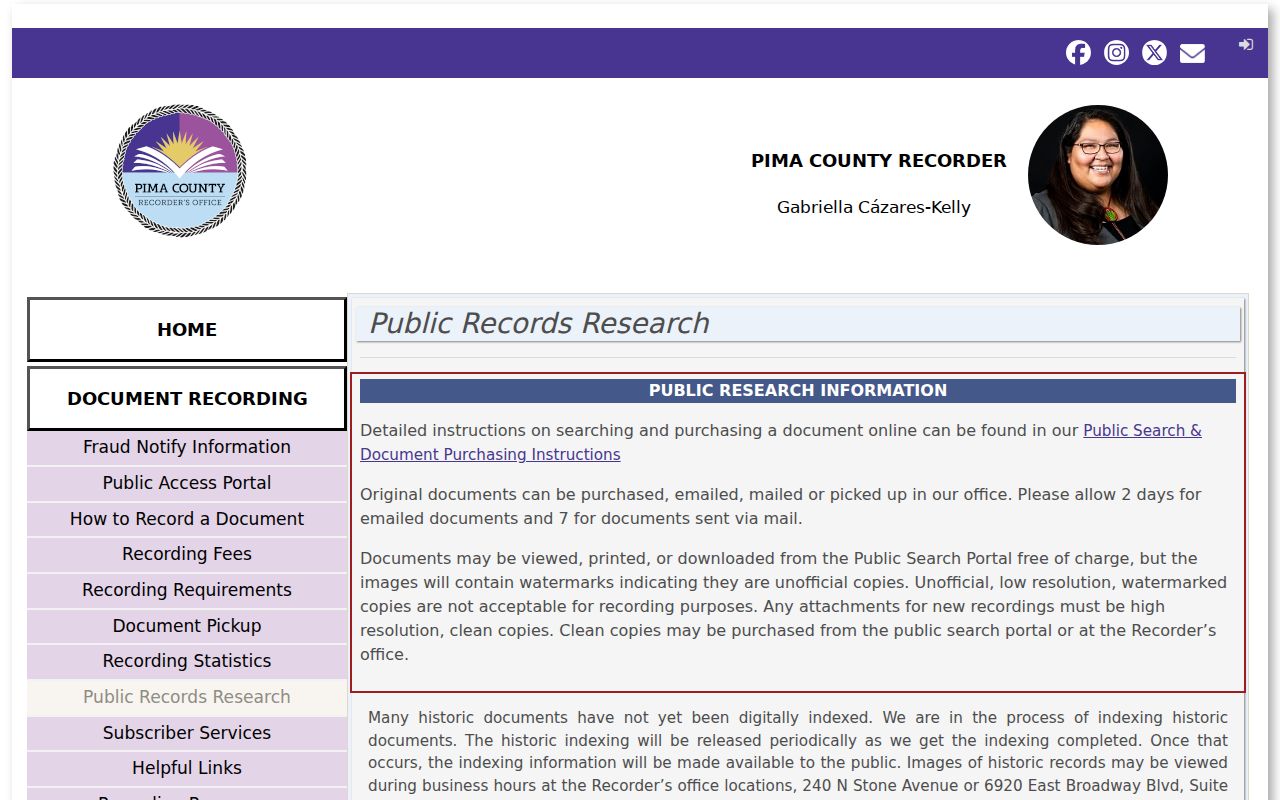
The screenshot shows the access point, not a complete historical index. Pima County, Arizona, downtown research at 240 N. Stone Ave. runs weekdays from 8 a.m. to 5 p.m.; the Eastside office at 6920 E. Broadway Blvd., Suite D, runs 8 a.m. to 4:30 p.m., closing noon to 1 p.m.
Elsewhere in Arizona, ask the county recorder about counter terminals, email or mail copies, and public-record requests. Arizona's public-record law permits inspection and copies, with applicable copy and postage charges. Name the parcel, parties, date range, and format.
Cross Arizona County and Court Boundaries
Arizona Territory was organized in 1863; the first four Arizona county governments began January 1, 1865; statehood followed February 14, 1912. Shifting boundaries can place an old Arizona address in another county or court district, so tracing previous residents may require the historic jurisdiction.
The Arizona State Archives holds territorial and Arizona state agency material from 1863 through the early 1990s and local records through the 1940s. Territorial district-court cases generally passed to Arizona county Superior Courts at statehood, except federal matters. Search the historic record group as well as the present clerk's file.
Pair Arizona Directory Years With Census Clues
City directories place a name at an address in a given year. The Arizona Memory Project and Arizona State Library describe nearly 400 digital directories from 1881 through 1989, with local gaps and unscanned print years. Alphabetical books run from name to address; a criss-cross directory runs from street and number to listed name. Search the Places We Lived collection, and see the Arizona city directory collections page for the broader shelf.
The Arizona State Library's request form asks for city, person or business, known address, and date. Staff search up to three consecutive or alternating years and can add obituary or newspaper questions. Broader indexed-book research gets a half hour; staff estimate costs, and copies over ten pages follow the fee schedule. It can target selected years for a previous residents search.
- Choose the Arizona directory closest to a deed date, move, or family event and copy the entry as printed.
- Ask for a preceding or following Arizona directory year, allowing for initials, a spouse's name, a business name, or an older street form.
- Pair the directory year with the nearest federal census schedule available under the 72-year release rule.
- Compare the Arizona street, county, and household geography; census boundaries and directory conventions may differ.
- Add Arizona newspaper, obituary, probate, map, or assessment-roll evidence to explain a name or address change.
Mail or email the form; visit the Arizona State Library or search local Arizona microfilm when the viewer lacks the year. An entry records one edition, not everyone in a home.
Use Arizona Maps to Reconcile Old Addresses
The Arizona State Archives Map Collection holds about 32,000 maps from the 1860s onward, including Sanborn microfilm, Maricopa land-ownership maps from 1903–1929, and Phoenix aerials from 1958–1997. Archival visits require an appointment.
Arizona Sanborn sheets can show a building footprint and street context, but coverage varies by city and year. The Library of Congress has selected digitized Arizona sheets in its Sanborn collection. Compare a historic map with a recorded plat and Arizona parcel layer; maps explain place, not who lived there.
Arizona Newspapers Close the House-History Trail
Arizona newspapers and probate can explain a change in owner or household name. Search a surname with an Arizona street, town, business, or relative for sale, marriage, death, estate, or heir notices. An obituary or court file may give a last address, but neither proves continuous residence. For previous residents, treat each notice as a dated lead to verify against the Arizona parcel record.
The Arizona Newspaper Project identified 1,520 titles in its 1991 survey, contacted libraries and other holders from 1994 to 2002, and cataloged 1,744 titles. More than one million pages had been filmed by 2003; the Arizona State Library now describes over two million microfilm pages. Digitized newspapers cover selected years from 1859 to 1989, while microfilm and print holdings extend beyond the online set.
Search the Arizona Newspaper Project catalog by title, city, county, subject, or OCLC number. Use the Reading Room, microfilm, or interlibrary route for gaps. Keep the paper title, date, page, and wording beside a related parcel or deed.
What Arizona Records Can Prove About Past Residents
An Arizona deed, directory, census, obituary, or court file records a person at a time under one set of rules. An owner may not have lived there; a directory may name only one household head; an Arizona probate file may name an heir but not each occupant. Match every claim to its source date and wording. Evidence about previous residents is dated and partial, not a complete household list.
For Arizona house history, pair a land record with a dated household clue and a map when the address shifted. Ask the custodian about unclear records. Keep private details out of public posts, especially for protected addresses or sealed cases.