
Arizona's City Directory Collections
Arizona has no single annual series that covers every town. The Arizona Memory Project gathers a statewide selection, while the Arizona State Library, local libraries, and historical repositories hold print and microfilm volumes that fill gaps. The Arizona collection table keeps statewide and city-specific runs distinct. Phoenix and Tucson have the deepest early Arizona examples shown here, but they are not the only places represented. A small Arizona town may appear in a state business directory, a telephone book, or a newspaper rather than a stand-alone city volume.
| Directory group | Verified years or scope | Holding place | How to reach it |
|---|---|---|---|
| Arizona city and business books | Nearly 400 digitized items, 1881–1989; 262 items in “The Places We Lived” | Arizona Memory Project and State Library print catalog | Search selected scans online; ask about print and microfilm gaps |
| Early Tucson titles in Arizona | 1881, 1883–1884, 1901, 1902 online; other microfilm years include 1899–1904, 1906–1907, 1912–1914 | Arizona Memory Project and Arizona Collection | Online for selected issues; appointment for Arizona Reading Room copies |
| Phoenix and Arizona's Salt River Valley | 1888, 1898–1906 and scattered 1912–1941 issues; microfilm also lists 1917–1919, 1929–1932, 1935–1938 | Arizona Memory Project, Arizona State Library, microfilm finding aid | Check each Arizona title and year; the run is not complete |
| Arizona statewide and special directories | Arizona business titles from 1881 and 1907–1913; Phoenix community directory, 1915–1916; telephone listings include 1927 | Arizona Memory Project and Arizona Collection | Search the Arizona title as well as the town; some runs are print only |
| Arizona newspapers and yearbooks | Newspapers, 1859–1989 digitized coverage; yearbooks, 1903–1996 | Arizona Memory Project, Arizona State Library, schools and local archives | Online selections, microfilm, Arizona Reading Room, or local collection |
The dates mark verified Arizona titles, not a promise of one volume for each year. Tucson examples include the 1881 Directory of the City of Tucson, an 1883–1884 Tucson and Tombstone general and business book, and 1901–1902 city and southern Arizona editions. Phoenix titles include Meyer's 1888 business book, city issues from 1898 and 1899–1900, Cox's 1900 business directory and map, A.P. Skinner's 1903 and 1905–1906 issues, and Salt River Valley volumes from 1912 onward. The span is scattered; a missing year may never have been published, may sit in print, or may be cataloged under another title. For another Arizona county or town, try the current place name and an older Arizona post-office or county name.
Search Arizona Directories in the Memory Project
The Arizona Memory Project's Places We Lived collection groups scanned city and business books from many parts of Arizona. Its page lists 262 items, while the Arizona State Library's genealogy collection page describes nearly 400 digitized directory items from 1881 to 1989. These counts describe different Arizona collection scopes. Search by title or town, then open the item record to confirm its date and whether it is an Arizona city, business, county, or telephone directory.
The Arizona Memory Project search supports text, item type, date limits, and different match rules. Its Arizona city-directory collection recommends a format filter and dates in month-day-year form. Its title list helps narrow the Arizona publication year before opening a scan.
| Search control | Choice or format | Useful check |
|---|---|---|
| Search text | Words for a person, business, town, or title | Try an old town name and a surname spelling variant |
| Item Type | Checkboxes; add a Format or Item Type field | Filter to City Directories for the Arizona collection |
| Within Data | Title Only, All fields, or All Fields + Content | Use broader fields when the surname is not in the title |
| Date From / To | Publication dates in MM-DD-YYYY format | Check the item record because yearly coverage has gaps |
| Search For | All Keywords, Any Keywords, or Exact Phrase Match | Switch to Any Keywords for uncertain initials or town names |
Open the Arizona Memory Project directory collection to compare item titles and dates before selecting a scanned volume.
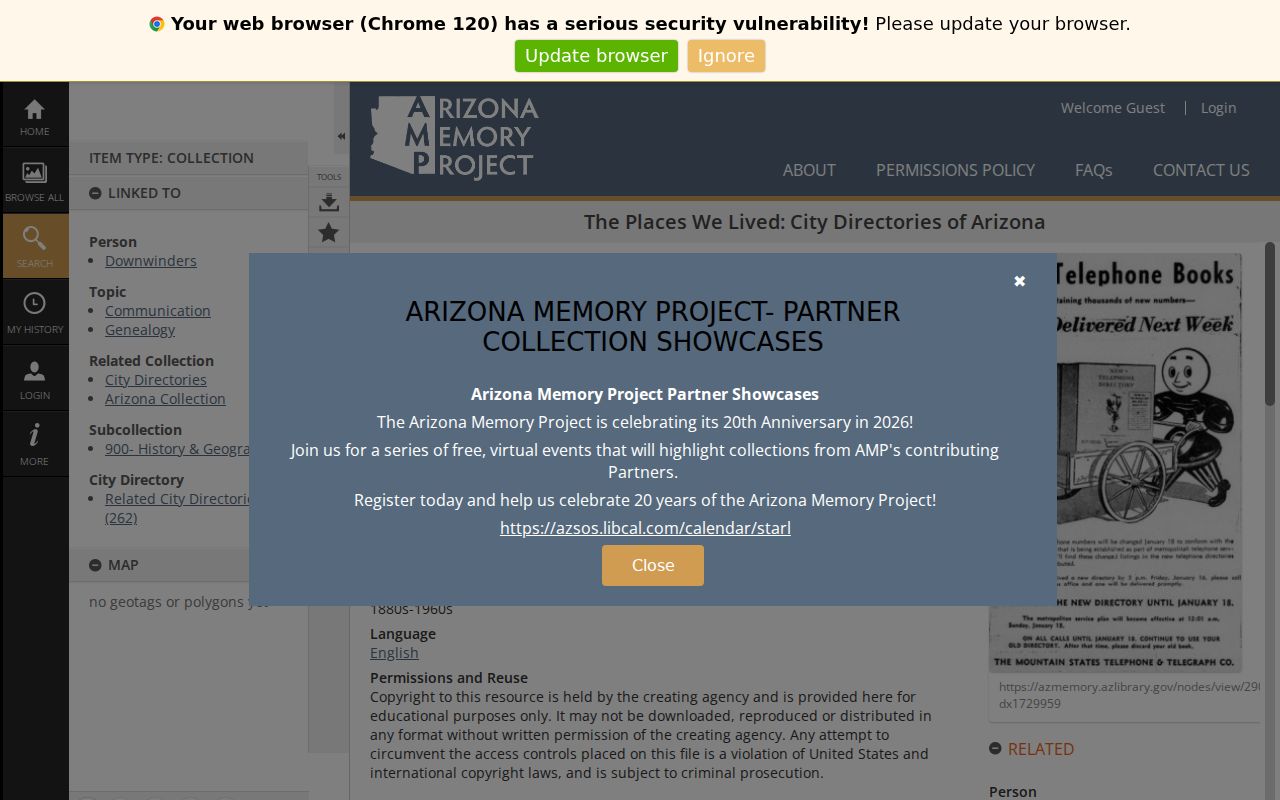
The collection view is a starting index, so confirm the place and year inside each item before using an entry as evidence.
Arizona State Library Access and Requests
The Arizona Collection at the Arizona State Library continues the Territorial Library founded in 1864. It holds city and telephone books, yearbooks, county and city reports, biographies, maps, vertical files, periodicals, and genealogy material. The Polly Rosenbaum Archives and History Building is at 1901 W. Madison St. in Phoenix; the library lists 602-926-3870 for the Reading Room. Archival visits require an appointment. The Arizona State Archives research page gives weekday appointment windows of 8:30 a.m. to noon and 1 to 4:30 p.m.; check current Arizona hours before travel.
Remote researchers can use the Arizona State Research Library request form. For a directory search, give the city, person or business, address if known, and the date. Staff will search up to three years, either in a row or as alternating years, and use the closest year held when the exact issue is absent. They do not guarantee a match. Scans or copies beyond ten pages follow the library fee schedule. Broader research in indexed books, periodicals, vertical files, or government documents is limited to a half hour of staff help; the library sends an estimate before that work begins. The form accepts mail or email requests; it lists research@azlibrary.gov, the 1901 W. Madison St. mail address, and phone 602-926-3870.
Start with the Arizona city or county library when a question concerns a small place, school, church, or local phone book. If that shelf has no run, ask the Arizona State Library about print and microfilm holdings, then check a county historical society, museum, tribal archive, or university special collection. The Arizona Historical Society Library and Archives contributed the Arizona City and Business Directories collection; its holdings are in Tempe, Tucson, and Flagstaff and require appointments. Use its catalog or finding aids to identify the holding site before making a request.
Reading an Arizona Directory Entry
Most personal listings in Arizona directories are alphabetical, so a name leads to a street address and often an occupation or business tie. An Arizona business section may work the other way: firm name to street, owner, or principal. In a later Arizona reverse volume, the street order can lead from a number to a listed occupant. Entries vary by publisher and year. These fields were verified in Arizona material, but their form is not fixed across books.
| Personal name | Spelling and initials as printed; a spouse may appear in parentheses |
|---|---|
| Work or business | Occupation, firm, street address, proprietor, or principal in the relevant section |
| Street address | House number and street; check the volume's own notation key |
| Household clue | Some Arizona entries can note a spouse, dependents, or owner/occupancy status |
| Family status | A widow or head-of-household mark may appear in local conventions |
| Record context | Directory title, publication year, page, and any telephone number shown |
- Criss-cross directory
- A reverse listing arranged by street address, useful when the street number is known but the occupant's name is not.
- Householder index
- An alphabetical list of people treated as household heads by that volume's editor; it may leave other residents out.
- Abbreviation key
- The publisher's guide to shortened words and marks, usually near the front; read it before expanding a symbol.
For a Phoenix supplement published in Arizona in 1955, the inspected entry style places a spouse's name in parentheses and may describe the count of children under eighteen. That detail is not universal across Arizona books. A missing spouse, child, or adult can reflect the directory's rules, a stale listing, or an editorial choice. Copy the full line and its page reference, then compare it with another Arizona year or a separate record before drawing a family conclusion.
Arizona Newspapers Fill Directory Gaps
Arizona's newspaper preservation work gives family and address research another dated source when a directory year is missing. A 1991 survey identified 1,520 newspaper titles. From 1994 through 2002, project staff contacted 166 libraries, archives, societies, museums, publishers, and private collectors; the project cataloged 1,744 titles and had filmed more than one million pages by 2003. The Arizona State Library now describes over two million newspaper pages on microfilm. That growth is a useful records story: a lost Arizona directory year may still leave a notice, business item, or street reference in print.
Search the Arizona State Library newspaper resources by title, city, county, subject, or OCLC number. The Arizona Memory Project has digitized newspaper coverage from 1859 to 1989; the Arizona Reading Room also offers microfilm and digital readers, while NewsBank and Gale OneFile are available there. More than 80 Arizona papers appear in the inspected NewsBank coverage from 1991 to current, and Gale OneFile includes nine titles. The Arizona State Library request form takes a specific newspaper title, obituary name, death date, and article date, and limits an Arizona newspaper search to a two-week period. Use an obituary, marriage notice, or business mention to explain why an Arizona name appears or disappears, then check the original issue date.
Tracing Arizona Families Through Directory Years
For a household trail in Arizona, pair an Arizona directory year with a census year, an obituary, and any known street or town name. The federal census is released under a 72-year rule, so 1940 and earlier schedules are broadly open; later years become available on their release dates. Arizona census boundaries and household rules may differ from those used by a city book. When the trail changes Arizona county, keep the earlier jurisdiction in the search instead of assuming today's map applied at the time.
- Choose the Arizona directory year closest to the event or known address, and copy the full entry and page.
- Check a prior and later issue; try initials, a middle name, a married name, and a spouse's name.
- Use a reverse section, when one exists, to see who the book listed at the street number.
- Pair the dated entry with the closest census year, keeping the different household rules in mind.
- Check newspapers, probate, cemetery records, and assessment rolls for a move, death, or surname change.
- Reconcile renamed streets, rural routes, annexations, and Arizona county borders before calling the listing a move.
A name that vanishes may mark a move, death, a new surname, or a missed edition. The entry alone cannot decide which. For a present-day parcel and deed trail, the Arizona street directory records use current address-based sources; for a modern person search across official records, see the Arizona resident lookup methods. Keeping the historical volume tied to its title and year makes those comparisons clearer.
Arizona City Directories Beyond Phoenix
A statewide search matters because smaller Arizona communities do not always have a surviving annual city volume. The 1881 Arizona Business Directory, the Arizona state business directories of 1907–1912, and Polk's 1912–1913 Arizona and New Mexico pictorial gazetteer can supply names or firms for places without a local run. Phoenix also has the 1915–1916 Directory of the Colored Population and a 1927 Summer Mountain States telephone directory. Search these Arizona items by their full titles. A community-specific directory may document people left out of a broad city book.
Arizona Memory Project and archive holdings also include nearly 600 Arizona yearbooks dated 1903–1996, church and school material, photographs, oral histories, cemetery files, and local business records. Try the relevant Arizona school or university archive, local library, county historical society, museum, tribal and community archive, or Arizona Historical Society. A public-facing organization directory generally gives a contact route, not a private member roll. These Arizona collections can add context to a name without turning one address entry into a list of everyone in a household.
Territorial Names in Arizona Records
Arizona's record trail crosses a government change. The Arizona Territory was organized in 1863, and Arizona became a state on February 14, 1912. Arizona's first four county governments began organization on January 1, 1865. The Arizona State Archives holds territorial and state agency records from 1863 into the early 1990s and local government records back to 1863, with local materials generally running through the 1940s. A person may therefore be indexed under an Arizona territory, county, judicial district, town, or post-office name that no longer matches the modern address.
At Arizona statehood, territorial district-court cases passed to county Superior Courts except for federal matters. Search Arizona government records and Great Registers alongside the current county clerk when an old name or court reference appears. For maps, the Arizona State Archives holds about 32,000 Arizona maps, including Sanborn microfilm, Maricopa land-ownership maps from 1903–1929, and Phoenix aerials from 1958–1997. These Arizona sources can explain a renamed road or changed boundary; they do not prove who lived at a place on their own. Keep an old Arizona spelling next to its modern form, and note the county and year attached to each record.