
Starting an Arizona Residents Directory Search
No single public roll lists every Arizonan. The best starting point depends on what you already know. An address works. So does a name, a court matter, or an older family link. An assessor record ties an owner to a parcel. The county recorder connects named parties to deeds and plats. Court and vital indexes answer narrower questions. Each source carries its own date range and access rule. Treat a single hit as a lead until a second record or the custodian confirms it.
Working from a home or street? Follow the address to the parcel, then to the recorded instrument. Working from a person? Anchor the search on a stable clue. County works. So do a middle initial, a known business, a spouse, or an old address. A historic Arizona city directory can place a name at an address in a past year. But it cannot prove who lives there now. Record the date, office, and search terms with every result. An empty result may simply mean another county holds the file. It may exist only on paper. Or a privacy rule may limit it. A careful residents directory search respects that limit. It avoids stretching an old entry into a present-day claim.
- Write down the Arizona county, full name, address, or parcel number already known, and preserve the original spelling.
- Use that county's assessor or GIS to check an Arizona parcel, owner name, situs address, and mailing address.
- Search the county recorder by party, address, APN, or legal description, then follow the Arizona deed chain.
- For a historical Arizona household, compare a directory year with a census, newspaper, map, or probate clue.
- If an Arizona portal stops at a date or omits the record, contact the custodian or library for its counter, request, and archival routes.
- Roll
- A list kept for a set purpose, such as an assessor's tax record or a voter file.
- Index
- A name or subject entry that points to a fuller Arizona record or image.
- Parcel
- A mapped piece of land with an assessor's identifying number.
- Criss-cross directory
- A directory ordered by street address so a reader can work from a place to a listed name.
Offices Behind Arizona's Resident Directory
Arizona spreads its records across 15 counties, state agencies, courts, cities, and libraries. The county recorder keeps deeds and plats. The assessor maintains the parcel and tax roll. The Clerk of the Superior Court holds county court files, and the Arizona State Archives preserves older government records. Different offices can hold pieces of one person's story. Use the county named on the parcel or case before sending any request, because a Phoenix-area example will not cover Tucson or a rural Arizona address.
Arizona State Archives
1901 W. Madison St.
Phoenix, AZ 85009
602-926-3720
Arizona research access by appointment
Arizona Vital Records
150 N. 18th Ave., Suite 120
Phoenix, AZ 85007
602-364-1300
Arizona certificate access follows eligibility rules
Arizona County Recorders
One Arizona recorder in each of 15 counties
Arizona county offices keep local records
Use the county contact list
The Arizona County Recorder Network
Arizona has 15 county recorder offices rather than one statewide deed counter. Each one records instruments for land within its own borders: deeds, deeds of trust, releases, liens, plats, easements, and similar filings. A statewide address search therefore starts by naming the county. Then it turns to that county's recorder. Arizona's official county recorder directory links to each local office. The Pima Public Records Research portal offers free watermarked images. It also points historical researchers to counter terminals when the index runs thin.
Coverage claims can describe different layers of the same collection. The Maricopa office reports an indexed collection dating to 1871. Yet its current full-text retrieval page limits that mode to the last two years while more data is added. So a blank result there does not mean an older Arizona deed is missing. Search by grantor or grantee name, a parcel's legal description, or a subdivision. When the online trail stops, ask the recorder for an older index or image. Pima makes historic images available at its Tucson research counters. This applies even where a historic name index is unfinished. Note also that online pages and official copies can carry different fees.
Recorders do not judge whether a filing proves residence or whether its legal claims hold up. A deed names the parties to a transfer. A lien or plat may explain land history without listing anyone's household. Keep the recording number, date, document type, parties, legal description, and image status together. When a digital result shows a gap, the next step is the county counter, a public-records request, or an archival reel.
Note: Maricopa's historic indexed collection and the shorter retrieval range described for its current full-text mode refer to separate search layers.
Arizona Court Case Search Limits
Arizona's statewide case lookup is called Public Access to Court Information. It comes from the Arizona Judicial Branch. The tool aids discovery, but it is not a full copy of any court file. It reaches 177 of 184 courts. Users must pass a CAPTCHA before searching. The service itself warns that results can be incomplete or out of date. Updates run each Friday with data through the prior Wednesday. Sealed cases stay out, along with juvenile, mental-health, probate, and victim or witness information. A same-name hit is only a lead; the filing court can confirm it.
Documents from Arizona Superior Court civil and criminal cases sit in a separate system. eAccess generally covers eligible filings back to July 1, 2010, though Pima County criminal filings start July 1, 2015. Some papers require purchase. Restricted or sealed files remain unavailable. When an Arizona matter does not appear online, the county Clerk of the Superior Court or the local municipal or justice court can help. That office can explain its public terminal, archive retrieval, copy, or certification process.
A public case record may list several details. These include a party name, case number, court, county, filing date, case type, events, and a disposition or status. A document link may open a separate image or purchase screen instead. Write down the case number, the exact court selector, and the date you searched. Common names demand care. Compare the county and other lawful details. Then ask the Arizona clerk to verify the docket before trusting the match.
Note: Arizona's public case index is a lead for a clerk search, and its exclusions can explain why a local file does not appear.
Arizona Residents Directory Sources Today
Arizona keeps current records that can tie a name to a parcel, a filing, or a voter status, but no single one is a complete roster of residents. Each source has its own keeper and its own access rule. One more wrinkle matters here: an Arizona record may carry a mailing address or business address that differs from where the person actually lives. Treat every match as a starting point.
| Arizona record | What it can show | Keeper | Access route |
|---|---|---|---|
| Arizona county assessor parcel roll | Recorded owner, parcel, situs and mailing addresses | County assessor | County portal, counter, or request |
| Arizona recorder index | Parties and details in deeds, liens, plats, and other instruments | County recorder | County search, counter, or copy request |
| Arizona voter record | One voter's own status; public file fields have limits | Arizona county recorder | Individual portal or authorized county request |
| Arizona public court case index | Case-number and filing-court leads | Arizona Judicial Branch and local courts | Online index, eAccess, or court clerk |
| Arizona business filing | Entity roles, agents, officers, and filing dates | Arizona Corporation Commission | Arizona Business Center search |
| Arizona city neighborhood or permit record | Organization boundaries or address-based city file clues | City or county office | Local portal or public-records request |
Match the Arizona source to the question. The assessor is strongest when the clue is land. A court index is a path to a docket. A city permit or code file may name an applicant. Yet it may not name every person at an address. The street-by-street record chain is laid out in the Arizona street directory section. For any record, note whether the page is an index, an image, or a certified copy. Those are different products.
The Arizona residents directory is a map to separate record keepers. It is not a roster assembled by one office. When a stronger match matters, lean on the custodian's own date, access terms, and correction path.
Official Arizona records name a source office, a record date, and an appeal or correction route. Commercial compilations may blend older public-record copies with other inputs. They can merge two people or hold a stale address. Compare the broad source types in the table before choosing which Arizona record to check:
| Source type | Best use | What to verify |
|---|---|---|
| Arizona custodian record | Trace a dated deed, parcel, docket, or public filing | County, record date, source office, and copy status |
| Commercial people-data summary | Generate a lead for a later official search | Source date, match quality, corrections, and fees |
- Roll
- An Arizona list kept for a set purpose, such as an assessor's tax record or a voter file.
- Index
- An Arizona name or subject entry that points to a fuller record or image.
- Parcel
- An Arizona mapped piece of land with an assessor's identifying number.
- Criss-cross directory
- An Arizona directory ordered by street address so a reader can work from a place to a listed name.
Arizona Public Records Request Steps
Arizona Public Records Law, A.R.S. §§39-121 through 39-121.03 opens a route to inspect or copy existing public records. The law covers the state, counties, cities, and other public bodies. Address the request to the office that keeps the record. Inspection is allowed during office hours. A requester may ask for copies, printouts, photographs, or a mailed copy. This helps when the material is not already online. Copy and postage charges may apply. Confidential records and protected details stay governed by their own laws and court rules.
A focused request is easier for an Arizona custodian to route. It works better than a broad ask about one person. Name the record series, the person or address, and a date span. State the format you want too. Arizona law asks for a noncommercial affirmation or a statement describing a commercial purpose. If a copy charge matters, ask about inspection first. Keep the response, the fee estimate, and any notes on how the request was narrowed.
- Identify the Arizona agency and custodian that holds the assessor card, deed, docket, permit, or directory volume.
- Give the exact name, address, APN, case number, or document number that can locate the Arizona record.
- Set a useful Arizona date range and say whether you want to inspect, receive a copy, or have a copy mailed.
- Ask for an Arizona public version with protected fields removed if the file contains confidential material.
Note: A request can seek a record that exists, but it does not require an Arizona office to create a new index or answer an open-ended research question.
Arizona Business Records Search
A deed, permit, or court filing may name an entity. The Arizona Corporation Commission's Arizona Business Center is the place to look. The public search accepts entity and docket searches. Documented fields cover entity name, statutory-agent name, principal name, entity ID, entity type, status, name type, and county. A detail record can show filing dates. It also lists agent and principal roles, officer names, status, and business addresses. An Arizona business address is an affiliation clue, not proof anyone lives there.
The portal replaced eCorp on January 12, 2026. If you are following an older filing or link, use the current Arizona Business Center entry point. Record the entity ID alongside the name. One agent can accept service for several companies. One office address can serve more than one entity. For a fuller Arizona trail, compare the filing against a county recorder record or a board's license entry. Then verify current status with the issuing office.
The Arizona Business Center public-records entry page shows where an entity or docket search begins.
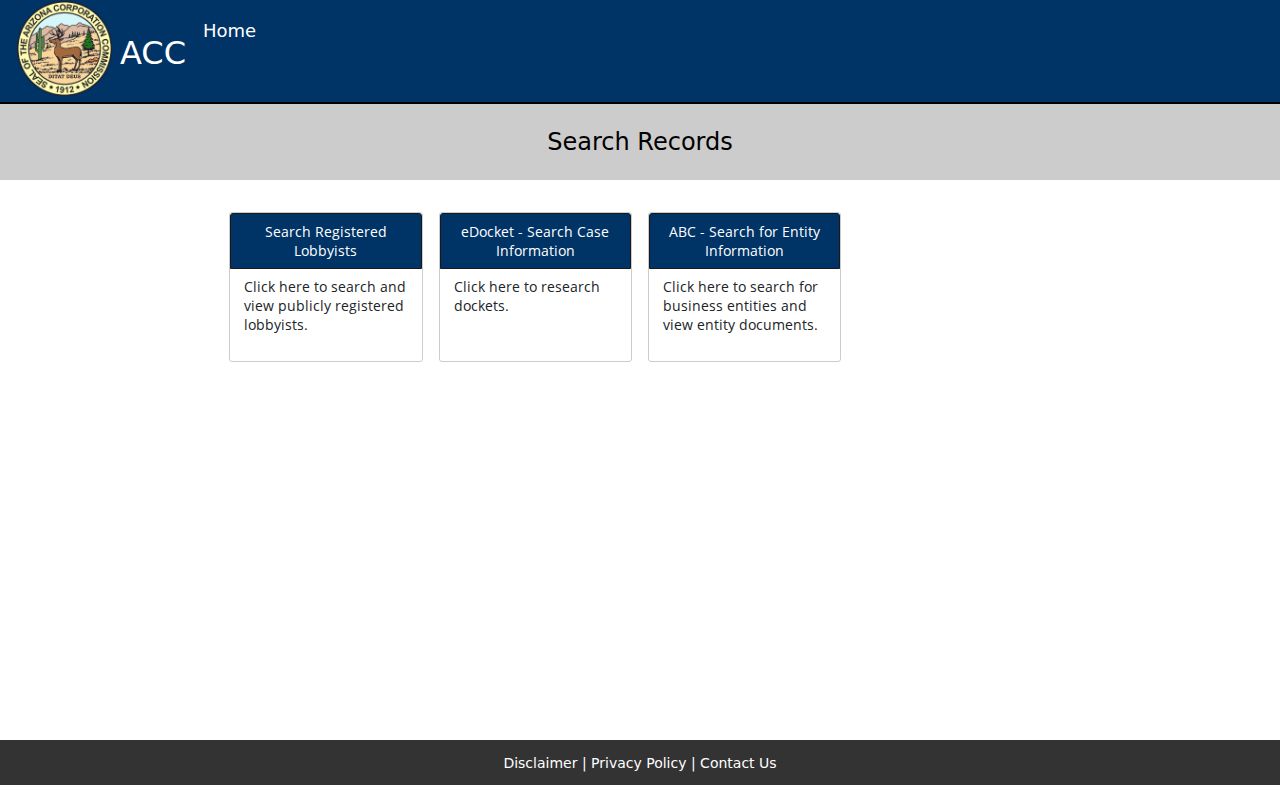
An Arizona business search ties a name to a dated public filing. Answering where someone lives takes a parcel or court source instead.
Old Arizona Residents Directory Collections
Arizona's online city-directory shelf holds nearly 400 items printed between 1881 and 1989. It is not a complete run for every town. The Arizona Memory Project's The Places We Lived collection gathers early Tucson titles and Phoenix city directories. It also includes Salt River Valley volumes, statewide business directories, and special community books. A single directory entry can tie a person to a street address. It may also list an occupation or a spouse. The entry could show a business, or a mark showing who still lived there. Read the key at the front of each volume first. One Arizona publisher's abbreviations do not always match another's. For past households, this Arizona residents directory history works best when each entry stays tied to its printed year.
What about years missing online? The Arizona State Library keeps print and microfilm copies for many of them. Its Reading Room sits in the Polly Rosenbaum Archives and History Building in Phoenix. Archival research there takes an appointment. Fill out the State Library's city-directory and newspaper request form with a city, a person or business, a known address, and a year. Staff will search up to three years, including alternating ones. The full Arizona city directory collections page shows how to pair those entries with census years and maps. That builds a stronger street directory trail.
Arizona Newspaper Project Archive
A directory year or deed index can have a gap. Arizona's newspaper preservation work is a strong fallback. A 1991 survey counted 1,520 newspaper titles statewide. Later cataloging raised that figure to 1,744 titles. The outreach covered libraries, archives, historical societies, museums, publishers, and private collectors. Project staff had filmed more than one million pages by 2003. The State Library now reports over two million Arizona newspaper pages on microfilm. Those figures describe scale, not coverage. Any given town or year may still not be digitized.
Search the Arizona Newspaper Project database by title, city, county, subject, or OCLC number. Then check the State Library's digital newspaper collection, Reading Room, microfilm, or interlibrary loan. Obituaries, marriage notices, and property sales help. So do probate notices and community items. Each can add a date or a relative to a record trail. A newspaper item may even explain why a name shifts between directories. The detail may matter. Pair the notice with a court, vital, or recorder record before you rely on it.
Arizona ZIP Codes and City Lines
An Arizona ZIP code is a postal routing label. It is not a city or county boundary. Confirm a street address with the USPS exact-address lookup. Then compare the result against the parcel's physical ZIP and county. Keep five fields separate in any Arizona search. These are post-office place, incorporated city, county, mailing ZIP, physical ZIP, and APN. Mixing them is the fastest way to lose a resident lookup.
Border cases are common. ZIP 85602 crosses Cochise and Pima county contexts in one documented example. Metro Phoenix ZIPs often serve places on opposite sides of city lines. Rural or tribal areas may use a post-office name that differs from the municipality. A ZIP search with no named resident list is expected. A postal polygon maps routes and parcels, not households. For a person-level clue, turn to the county assessor. An authorized roll works better than the ZIP code directory.
Note: The Arizona ZIP layer is a boundary aid, while USPS confirms delivery codes for a specific address.
Protected Arizona Resident Addresses
Some Arizona records hide an address. Others limit who may view it. The Arizona Address Confidentiality Program gives qualifying people a substitute address plus mail forwarding. It covers domestic violence, sexual offenses, or stalking. Arizona agencies must accept that substitute address in covered records. A participant can also request redaction of the actual address. The program's rules govern that step for recent records. A.R.S. §16-153 separately shields identifying details for eligible people in voter rolls. So a missing Arizona address may reflect a privacy rule rather than a failed search.
Arizona adds record-specific limits for vital records. Court files face their own limits. So do protected-person redactions handled by a recorder. Ask the official custodian about a correction or an eligibility question. Removing a commercial copy changes nothing at the county's source record. Public access never permits tracking, threatening, or repeatedly contacting someone. Arizona law treats harassment and stalking as crimes under A.R.S. §§13-2921 and 13-2923.
Arizona Record Scam Warnings
Arizona officials keep warning about messages that impersonate agencies, courts, or delivery services. A June 2025 Attorney General alert flagged fake texts using agency names and links. Another warning described an alleged deed-transfer scheme aimed at vulnerable property owners. The safe habit is simple. Open the official Arizona portal yourself. Read the fee page. Check a recorded instrument with the county recorder. Do that before paying a stranger or signing anything.
Suppose a notice claims a court, assessor, or recorder found a problem. Call that office through its official Arizona phone number or website. Never use the number inside the message. Compare the document number and fee against the custodian's public information. The Arizona record trail works best with clean custody. Every name, date, parcel, and case stays tied to the office that created it. Treat a search result as a starting point. An authenticated copy or a clerk confirmation answers the next question.
Arizona Voter Lookup Boundaries
The Arizona Voter Information Portal serves one voter at a time. It is built for checking your own registration, not for browsing a street directory. The search asks for identity or address details. That way each voter reaches a single record. Public-file requests follow a different path. They go through the county recorder, subject to A.R.S. §§16-153 and 16-168. Some identifying fields stay withheld, and distribution and use of the voter file are restricted. A precinct entry can confirm a registration fact at a point in time. It cannot show where every person on an Arizona block lives today.
The portal's own search choices draw the boundary clearly. Maricopa and Pima push some address functions to county tools instead. A CAPTCHA may appear along the way. An Arizona voter who wants a status check should use the official Voter Information Portal. It is linked with the statewide lookups. For authorized requests, ask the county recorder. Ask about permitted fields, the inspection or copy process, and the required purpose statement under A.R.S. §16-168.
| Arizona portal field | Input | Search note |
|---|---|---|
| County | Select list | Choose the Arizona county tied to registration. |
| Last Name | Text | Used with the Arizona voter search. |
| Date of Birth | Date | Identity clue for the Arizona voter's own status check. |
| Identification Method / Number | Select and conditional text | Options depend on information supplied at Arizona registration. |
| Residence Address | Address | Some Maricopa and Pima functions route to county tools. |
| Recaptcha, Clear, Search | Verification and buttons | The Arizona page shows verification and exact control labels. |
Note: Arizona's voter portal is a self-check service, while lawful access to county-held voter files follows separate rules.