
Starting an Arizona Residents Directory Search
Arizona has no single public roll that lists every person in the state. The useful starting point depends on whether the known fact is an Arizona address, a name, a court matter, or an older family link. An assessor record ties an owner to a parcel; the county recorder links named parties to deeds and plats; court and vital indexes answer narrower questions. Each Arizona source has its own date range and access rule. A match in one index should be treated as a lead until a second record or the custodian confirms it.
For an Arizona home or street, follow the address to the parcel and then to the recorded instrument. For one person, compare a stable clue such as county, middle initial, known business, spouse, or old address. A historic Arizona directory can place a name at an address in a past year, but it cannot establish a current household. Keep the record date, office, and search terms with each result. If a search comes up empty, Arizona records may be held by another county, kept only on paper, or withheld under a specific privacy rule. A careful Arizona residents directory search preserves that limit instead of turning an old entry into a present-day claim.
- Write down the Arizona county, full name, address, or parcel number already known, and preserve the original spelling.
- Use that county's assessor or GIS to check an Arizona parcel, owner name, situs address, and mailing address.
- Search the county recorder by party, address, APN, or legal description, then follow the Arizona deed chain.
- For a historical Arizona household, compare a directory year with a census, newspaper, map, or probate clue.
- If an Arizona portal stops at a date or omits the record, contact the custodian or library for its counter, request, and archival routes.
- Roll
- A list kept for a set purpose, such as an assessor's tax record or a voter file.
- Index
- A name or subject entry that points to a fuller Arizona record or image.
- Parcel
- A mapped piece of land with an assessor's identifying number.
- Criss-cross directory
- A directory ordered by street address so a reader can work from a place to a listed name.
Offices Behind Arizona's Resident Directory
Arizona records are spread among 15 counties, state agencies, courts, cities, and libraries. The county recorder keeps deeds and plats, the assessor maintains the parcel and tax roll, and the Clerk of the Superior Court holds county court files. The Arizona State Archives preserves older government records. These are different offices, even when the records describe one person or address. Use the Arizona county named on the parcel or case before sending a request, since a Phoenix-area example does not cover Tucson or a rural Arizona address.
Arizona State Archives
1901 W. Madison St.
Phoenix, AZ 85009
602-926-3720
Arizona research access by appointment
Arizona Vital Records
150 N. 18th Ave., Suite 120
Phoenix, AZ 85007
602-364-1300
Arizona certificate access follows eligibility rules
Arizona County Recorders
One Arizona recorder in each of 15 counties
Arizona county offices keep local records
Use the county contact list
The Arizona County Recorder Network
Arizona has 15 county recorder offices, not one statewide deed counter. Each records instruments for land in its county, including deeds, deeds of trust, releases, liens, plats, easements, and other filings. A statewide address search therefore begins with the county and then moves to that county's recorder. Arizona's official county recorder directory links to local offices. The Pima Public Records Research portal offers free watermarked images and directs historical researchers to counter terminals when indexing is incomplete.
Coverage statements can describe different layers. The Maricopa office reports an indexed collection dating to 1871, but its current full-text retrieval page says that mode reaches the last two years as more data is added. A blank result in that search does not show that an older Arizona deed is absent. Search a grantor or grantee name, parcel's legal description, or subdivision, then ask the recorder for an older index or image when needed. Pima makes historic images available at its Tucson research counters even when a historic name index is unfinished. Online pages and official copies can also have different fees.
Arizona recorders do not decide whether a filing proves residence or whether its legal claims are correct. A deed names parties to a transfer; a lien or plat may explain land history without listing the household. Keep the recording number, date, document type, parties, legal description, and image status together. The county counter, public-records request, or archival reel is the next step when a digital result has a gap.
Note: Maricopa's historic indexed collection and the shorter retrieval range described for its current full-text mode refer to separate search layers.
Arizona Court Case Search Limits
The Arizona Judicial Branch's Public Access to Court Information is a statewide discovery tool, not a copy of the court file. It covered 177 of 184 courts when inspected and asks users to pass a CAPTCHA before searching. The service warns that results can be incomplete or stale and says updates run each Friday for data through the prior Wednesday. Sealed cases and several protected categories, including juvenile, mental-health, probate, and victim or witness information, are excluded. A same-name result needs confirmation from the filing court.
Arizona Superior Court civil and criminal documents are a separate step. eAccess generally covers eligible filings from July 1, 2010; Pima criminal filings begin July 1, 2015. Some documents require purchase, and restricted or sealed files remain unavailable. If an Arizona matter is not online, ask the county Clerk of the Superior Court or the local municipal or justice court about its public terminal, archive retrieval, copy, or certification process.
A public case result may show a party name, case number, court, county, filing date, case type, events, and a disposition or status when exposed. A public document link may lead to a separate image or purchase screen. Save the search date and exact court selector along with the case number. If the name is common, compare county and other lawful details, then ask the Arizona clerk to verify the docket before treating it as the right person.
Note: Arizona's public case index is a lead for a clerk search, and its exclusions can explain why a local file does not appear.
Arizona Residents Directory Sources Today
Arizona has current records that can connect a name with a parcel, filing, or voter status, but none is a complete list of residents. The keeper and access rule vary by source. A record in one Arizona system can also use a mailing address or business address that differs from a person's home.
| Arizona record | What it can show | Keeper | Access route |
|---|---|---|---|
| Arizona county assessor parcel roll | Recorded owner, parcel, situs and mailing addresses | County assessor | County portal, counter, or request |
| Arizona recorder index | Parties and details in deeds, liens, plats, and other instruments | County recorder | County search, counter, or copy request |
| Arizona voter record | One voter's own status; public file fields have limits | Arizona county recorder | Individual portal or authorized county request |
| Arizona public court case index | Case-number and filing-court leads | Arizona Judicial Branch and local courts | Online index, eAccess, or court clerk |
| Arizona business filing | Entity roles, agents, officers, and filing dates | Arizona Corporation Commission | Arizona Business Center search |
| Arizona city neighborhood or permit record | Organization boundaries or address-based city file clues | City or county office | Local portal or public-records request |
Choose the Arizona source that fits the question. The assessor is strongest when the clue is land; a court index is a path to a docket; a city permit or code file may name an applicant but not every person at an address. The street-by-street record chain is covered in the Arizona street directory section. For other records, note whether the page is an index, an image, or a certified copy, because those are different products.
The Arizona residents directory is a map to separate record keepers, not a roster assembled by one office. Use the custodian's own date, access terms, and correction path when you need a stronger match.
Official Arizona records identify a source office, record date, and an appeal or correction route. Commercial data compilations may combine older public-record copies and other inputs, but can merge two people or retain a stale address. Use the table to compare broad types of source before deciding which Arizona record to check:
| Source type | Best use | What to verify |
|---|---|---|
| Arizona custodian record | Trace a dated deed, parcel, docket, or public filing | County, record date, source office, and copy status |
| Commercial people-data summary | Generate a lead for a later official search | Source date, match quality, corrections, and fees |
- Roll
- An Arizona list kept for a set purpose, such as an assessor's tax record or a voter file.
- Index
- An Arizona name or subject entry that points to a fuller record or image.
- Parcel
- An Arizona mapped piece of land with an assessor's identifying number.
- Criss-cross directory
- An Arizona directory ordered by street address so a reader can work from a place to a listed name.
Arizona Public Records Request Steps
Arizona Public Records Law, A.R.S. §§39-121 through 39-121.03, gives a route to inspect or request copies of existing public records from the state, county, city, and other public bodies. Send the request to the office that keeps the record. The law allows inspection during office hours, and a requester may ask for copies, printouts, photographs, or a mailed copy when it is not already available online. Copy and postage charges may apply. Confidential records and protected details remain subject to their own laws and court rules.
A focused request is easier for an Arizona custodian to route than a broad ask for everything about one person. Name the record series, the person or address, a date span, and the format you want. Arizona law calls for a noncommercial affirmation or a statement describing a commercial purpose under the statute. Ask first whether inspection is available if a copy charge matters, and keep the response, fee estimate, and any narrowing notes.
- Identify the Arizona agency and custodian that holds the assessor card, deed, docket, permit, or directory volume.
- Give the exact name, address, APN, case number, or document number that can locate the Arizona record.
- Set a useful Arizona date range and say whether you want to inspect, receive a copy, or have a copy mailed.
- Ask for an Arizona public version with protected fields removed if the file contains confidential material.
Note: A request can seek a record that exists, but it does not require an Arizona office to create a new index or answer an open-ended research question.
Arizona Business Records Search
The Arizona Corporation Commission's Arizona Business Center is a useful source when a deed, permit, or court filing names an entity. The public search entry accepts entity and docket searches, with fields documented for entity name, statutory-agent name, principal name, entity ID, entity type, status, name type, and county. Its detail records can show filing dates, agent and principal roles, officer names, status, and business addresses. An Arizona business address is an affiliation clue, not proof that a person lives there.
The Arizona portal replaced eCorp on January 12, 2026. When following an older filing or link, check the current Arizona Business Center entry point and record the entity ID with the name. An agent may accept service for several companies, and an office address can serve more than one entity. For a fuller Arizona trail, compare the filing with a county recorder record or a board's license entry, then verify the current status at the issuing office.
The Arizona Business Center public-records entry page shows where an entity or docket search begins.
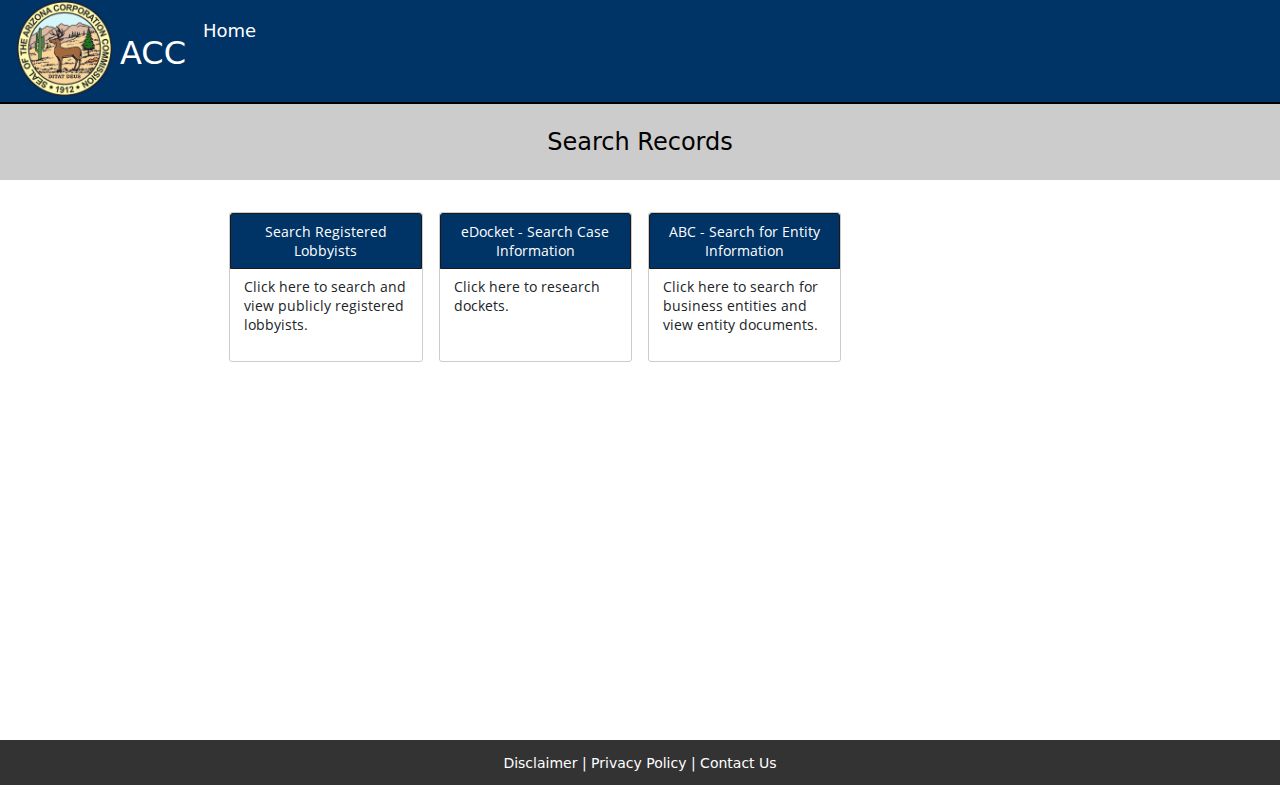
The Arizona business search can connect a name to a dated public filing, while a parcel or court source is still needed to answer a different question.
Old Arizona Residents Directory Collections
Arizona's digital city-directory shelf spans nearly 400 items from 1881 through 1989, but it is not a year-by-year run for every town. The Arizona Memory Project's The Places We Lived collection shows early Tucson titles, Phoenix city directories, Salt River Valley runs, statewide business directories, and special community volumes. A directory can connect a named person to an address and sometimes an occupation, spouse, business, or occupancy mark. Read the opening key for that volume, because an abbreviation in one Arizona publisher's book may mean something else in another. This Arizona residents directory history is useful for past households, with each entry kept tied to its printed year.
The Arizona State Library keeps print and microfilm material for years missing from the online collection. Its Reading Room is in the Polly Rosenbaum Archives and History Building in Phoenix, and archival research requires an appointment. The State Library's city-directory and newspaper request form accepts a city, person or business, known address, and year; staff search up to three years, including alternating years. The full Arizona city directory collections page explains how to combine those entries with census years and maps.
Arizona Newspaper Project Archive
Arizona's newspaper preservation work is a strong fallback when a directory year or deed index leaves a gap. A 1991 survey identified 1,520 newspaper titles; later statewide work cataloged 1,744 titles after contacting libraries, archives, historical societies, museums, publishers, and private collectors. By 2003, project staff had filmed more than one million pages. The State Library now reports more than two million Arizona newspaper pages on microfilm. Those numbers describe the scale of the collection, not a promise that any one town or year has been digitized.
Search the Arizona Newspaper Project database by title, city, county, subject, or OCLC number, then check the State Library's digital newspaper collection, Reading Room, microfilm, or interlibrary-loan route. An obituary, marriage notice, property sale, probate notice, or community item may add a date or relative to a record trail. Arizona newspapers can help explain why a name changes between directories, but the notice should be paired with a court, vital, or recorder record when the detail matters.
Arizona ZIP Codes and City Lines
An Arizona ZIP code is a postal routing label, not a city or county boundary. Use the USPS exact-address lookup to confirm a street address, then compare it with the parcel's physical ZIP and county. Keep the post-office place, incorporated city, county, mailing ZIP, physical ZIP, and APN as separate fields in an Arizona search.
ZIP 85602 is one documented Arizona border case that crosses Cochise and Pima county contexts. Metro Phoenix ZIPs also serve places on different sides of city lines, while rural and tribal areas may use a post-office name that differs from the municipality. If an Arizona ZIP search returns no named resident list, that is expected: a postal polygon locates routes and parcels, not every household. Check the county assessor or an authorized roll for a person-level clue.
Note: The Arizona ZIP layer is a boundary aid, while USPS confirms delivery codes for a specific address.
Protected Arizona Resident Addresses
Some Arizona records hide an address or limit who can see it. The Arizona Address Confidentiality Program provides a substitute address and mail forwarding for qualifying people affected by domestic violence, sexual offenses, or stalking. Arizona agencies must accept the substitute address in covered records, and a participant can request redaction of the actual address from recent records under the program's rules. A.R.S. §16-153 separately protects identifying details for eligible people in voter records. These safeguards mean that a missing Arizona address can reflect a privacy rule rather than a failed search.
Arizona also has record-specific limits for vital records, court files, and protected-person redactions by a recorder. Use the official custodian for a correction or eligibility question; removing a commercial copy does not change the county's source record. Public access does not give permission to track, threaten, or repeatedly contact someone. Arizona law addresses harassment and stalking in A.R.S. §§13-2921 and 13-2923.
Arizona Record Scam Warnings
Arizona officials have warned about messages that impersonate government agencies, courts, or delivery services and ask for money or personal details. A June 2025 Attorney General alert described fake texts using agency names and links. Another warning described an alleged deed-transfer scheme aimed at vulnerable property owners. These reports make it sensible to open the official Arizona portal yourself, read the fee page, and check a recorded instrument with the county recorder before paying a stranger or signing a document.
If a notice claims that a court, assessor, or recorder found a problem, contact that office using its official Arizona phone number or website, not the number in the message. Compare the document number and fee with the custodian's public information. The Arizona record trail is most useful when every name, date, parcel, and case is tied to the office that created it. A search result is a starting point; an authenticated copy or clerk confirmation answers the next question.
Arizona Voter Lookup Boundaries
The Arizona Voter Information Portal is for an individual checking their own registration. It is not a public by-street directory. The search asks for identity or address details so the voter can reach their record, while authorized public-file requests go through the county recorder and remain subject to A.R.S. §§16-153 and 16-168. Some identifying fields are withheld, and voter-file distribution and use are restricted. An Arizona precinct entry can show a registration fact at a point in time, but it does not establish where every person on a block lives now.
The individual portal's visible search choices help explain the boundary. Maricopa and Pima direct some address functions to county tools, and a CAPTCHA may appear. For an Arizona voter who needs a status check, use the official Voter Information Portal linked with the statewide lookups. For an authorized records request, ask the county recorder about the permitted fields, inspection or copy process, and required purpose statement under A.R.S. §16-168.
| Arizona portal field | Input | Search note |
|---|---|---|
| County | Select list | Choose the Arizona county tied to registration. |
| Last Name | Text | Used with the Arizona voter search. |
| Date of Birth | Date | Identity clue for the Arizona voter's own status check. |
| Identification Method / Number | Select and conditional text | Options depend on information supplied at Arizona registration. |
| Residence Address | Address | Some Maricopa and Pima functions route to county tools. |
| Recaptcha, Clear, Search | Verification and buttons | The Arizona page shows verification and exact control labels. |
Note: Arizona's voter portal is a self-check service, while lawful access to county-held voter files follows separate rules.